


Every piece I’ve bought has held up, looks great, and is actually comfortable to wear—can’t say that about a lot of brands. I’m hooked. Nothing else I’ve found comes close.


 Murray Rothbard was one of the most original and uncompromising thinkers of the twentieth century. He critiqued the state with unmatched ferocity and then went further, building a philosophical framework to show why it was unnecessary, destructive, and morally indefensible. His work fused economics, history, and political theory into a unified defense of liberty, leaving behind a body of writing that continues to shape debates about freedom.
Born in 1926 in New York City, Rothbard studied economics at Columbia University and came under the influence of Ludwig von Mises, the great Austrian economist. From Mises he took the insight that markets are driven by human choice, not mathematical abstractions. Rothbard expanded this into a discipline he called praxeology—the study of purposeful human action—and applied it across the full spectrum of economic life. His magnum opus, Man, Economy, and State (1962), was a systematic and rigorous explanation of how markets function when left free of political interference.
But Rothbard was never content to stop at economics. He saw that questions of liberty also belonged to history, philosophy, and law. His multi-volume Conceived in Liberty retold the American founding as a radical struggle for independence, not a tidy tale of constitution-writing. In America’s Great Depression he showed how government policies, not markets, caused the collapse of the 1930s. His political theory pushed further than the “limited government” crowd was comfortable with, arguing that if monopoly is destructive in the marketplace, it is even worse when granted to the state. From this logic he advanced the case for a stateless society rooted in voluntary exchange and private law—a philosophy now called anarcho-capitalism.
Rothbard also reshaped the way people read history itself. He practiced what he called “revisionist history,” not in the pejorative sense, but as a determination to challenge official myths. He showed how wars, central banking, and corporatism were sold as progress while serving as vehicles for power and plunder. His willingness to go back to first principles made him an iconoclast, but it also made him a guide for those tired of polite fictions.
The sheer scale of his output was staggering. He wrote thousands of pages across economics, philosophy, history, and strategy, often in prose that was as sharp as it was accessible. He had no patience for jargon or academic posturing. Whether demolishing Keynesian models, exposing the costs of interventionism, or arguing against foreign wars, his style was direct, energetic, and relentlessly clear.
Many dismissed him as extreme, but his ideas refused to go away. Today his influence runs through modern libertarianism, critiques of central banking, and every serious conversation about the limits of government power. Rothbard gave the liberty movement its intellectual backbone and its nerve, showing that the state is not the source of prosperity but the greatest barrier to it.
Every piece I’ve bought has held up, looks great, and is actually comfortable to wear—can’t say that about a lot of brands. I’m hooked. Nothing else I’ve found comes close.
Finally, a brand that’s got some guts! I ordered a shirt just for laughs, but now I’m back getting them as gifts for the whole family. No cheap prints or lame designs—this is the real deal.

My husband loved it. One shirt had to be exchanged, but it was easy. Will buy again.

Tiger stripes! Another cool manics shirt. Thanks guys!

Savage designs. I occasionally wear my shirts to work under another shirt and smile. They finally have really nice heavy tees that don't feel stiff. I didn't like their old zip hoodies because they were too lightweight and made by American Apparel, but now they have heavier ones that hold up.

Great quality. Most ‘patriotic’ gear is all flash, no quality, but not Liberty Maniacs. They’re clever, sharp, and have a sense of humor without being tacky. Proud to wear this stuff.

Super soft and insanely comfortable! I love my shirt, and my husband loves his hoodie… or should I say my new hoodie since I keep ‘borrowing’ it while he’s at work. It's definitely our favorite brand now.

Nice quality, soft cozy material.
Will definitely buy more. Shipping came on time. The sizing was good, and I got a ton of compliments on it.

This shirt? Chef’s kiss. Rocked it around town, and let’s just say it got some looks—can’t argue with launching a few politicians via catapult. Soft as hell material. 10/10

Great fit and quality as always!

I've learned to be more discriminating about the companies I buy from. I've been happy with both orders. Keep up the good work.

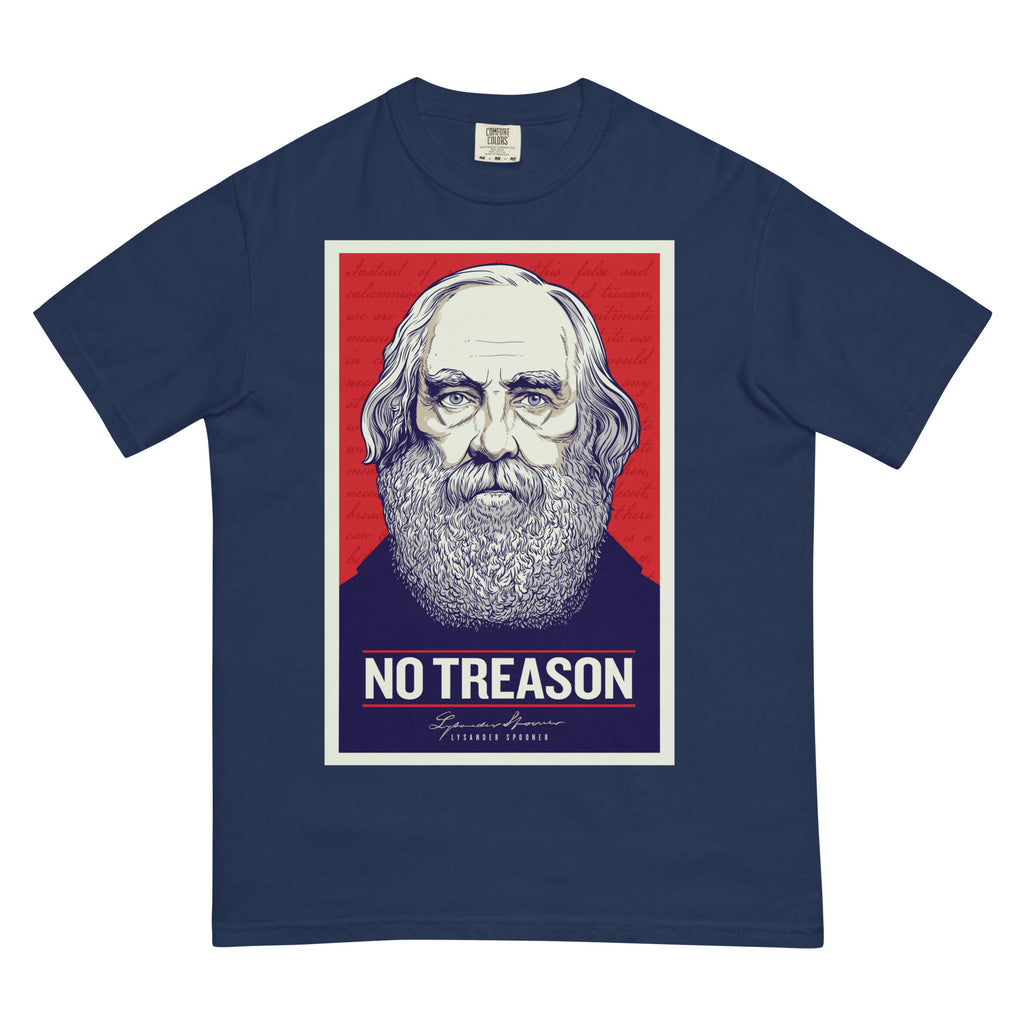
Liberty Maniacs nails it with the patriotic gear. I got the shirt with Lysander Spooner, and it’s hands down my new favorite. Not only is the design legit, but it actually feels like a shirt I want to wear (super soft, if you’re wondering). Plus, half the fun is when someone recognizes it. Can’t wait to see what other historical gems they come out with!
